01
Unified Stereo Geometry Estimation
GeoStereo couples feed-forward stereo matching with diffusion-based surface normal estimation under a shared feature extractor, allowing both tasks to exchange complementary geometric priors.
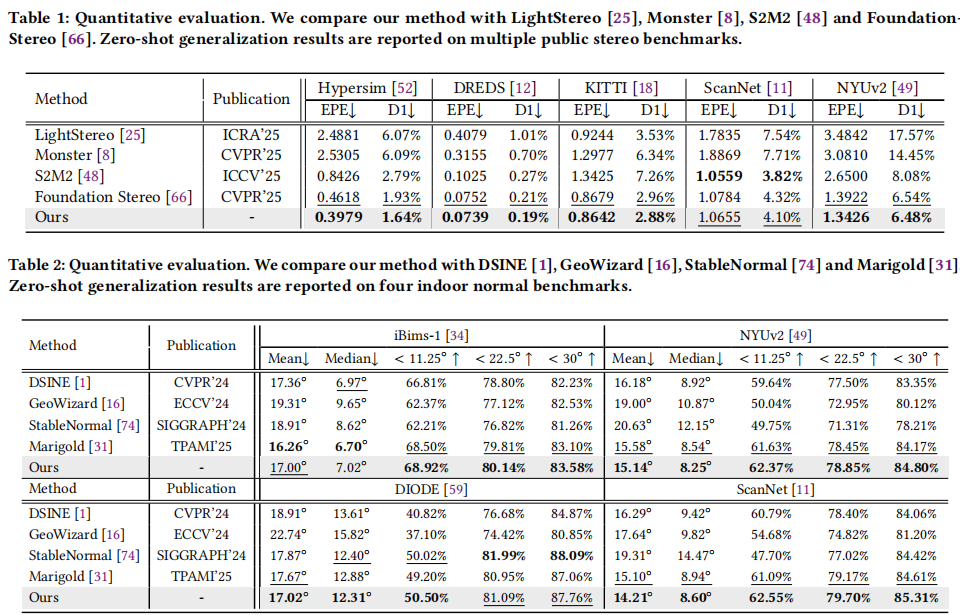
Stereo matching and surface normal estimation provide complementary geometric cues, yet existing methods often model them independently and remain unreliable in low-light, reflective, and transparent regions. We present GeoStereo, a unified stereo geometry estimation framework that jointly predicts disparity and surface normals. GeoStereo couples a feed-forward stereo branch with a diffusion-based normal branch through a shared feature extractor, disparity-to-normal initialization, and aligned cross-view guidance. This design allows diffusion priors to improve disparity estimation in ill-posed regions, while stereo geometry provides structured guidance for normal prediction. Extensive zero-shot experiments demonstrate strong generalization across challenging scenes. GeoStereo achieves Rank-1 disparity performance on multiple benchmarks, including KITTI and NYUv2, and obtains the best normal estimation error on several real indoor datasets.
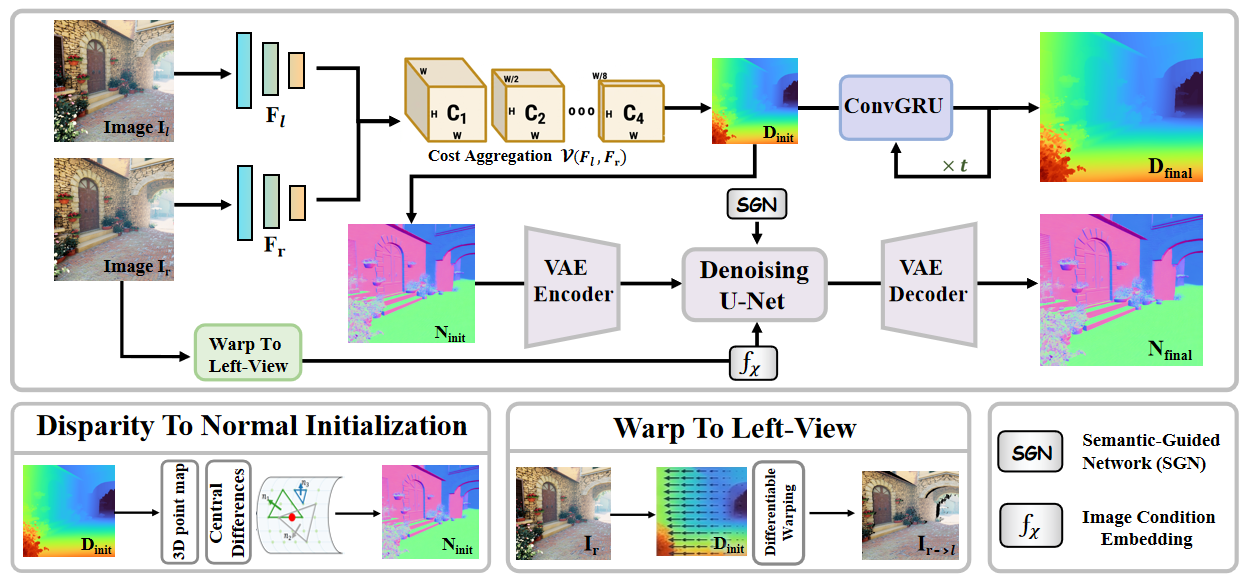
Overview of our proposed framework. A stereo pair is first processed by a shared feature extractor to obtain shared features, which are aggregated to predict disparity and further refined by a ConvGRU. The initial disparity is converted into a disparity-to-normal initialization and, together with the shared left-view features and the warp-to-left-view condition, is fed into a diffusion-based U-Net. The latent is iteratively refined and decoded to produce the final normal map.
GeoStereo couples feed-forward stereo matching with diffusion-based surface normal estimation under a shared feature extractor, allowing both tasks to exchange complementary geometric priors.
The initial disparity is converted into a coarse normal initialization, providing a structured starting point for diffusion denoising while preserving consistency with stereo geometry.
The right image is differentiably warped into the left-view coordinate system using predicted disparity, supplying aligned binocular cues for normal refinement in occluded and ambiguous regions.
The diffusion branch contributes strong structural priors in low-light, reflective, transparent, and weak-texture regions, improving both disparity robustness and fine-grained surface geometry.
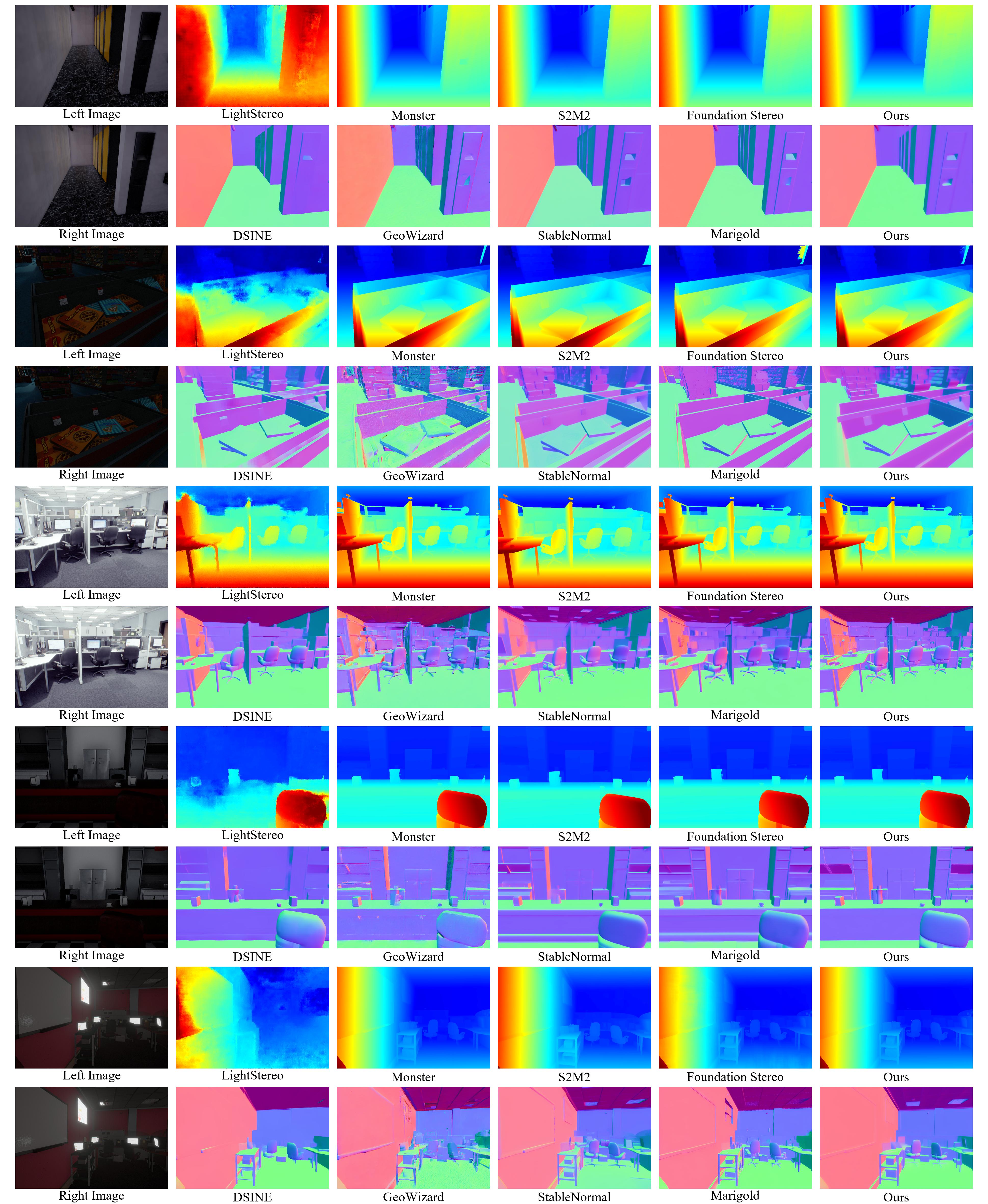
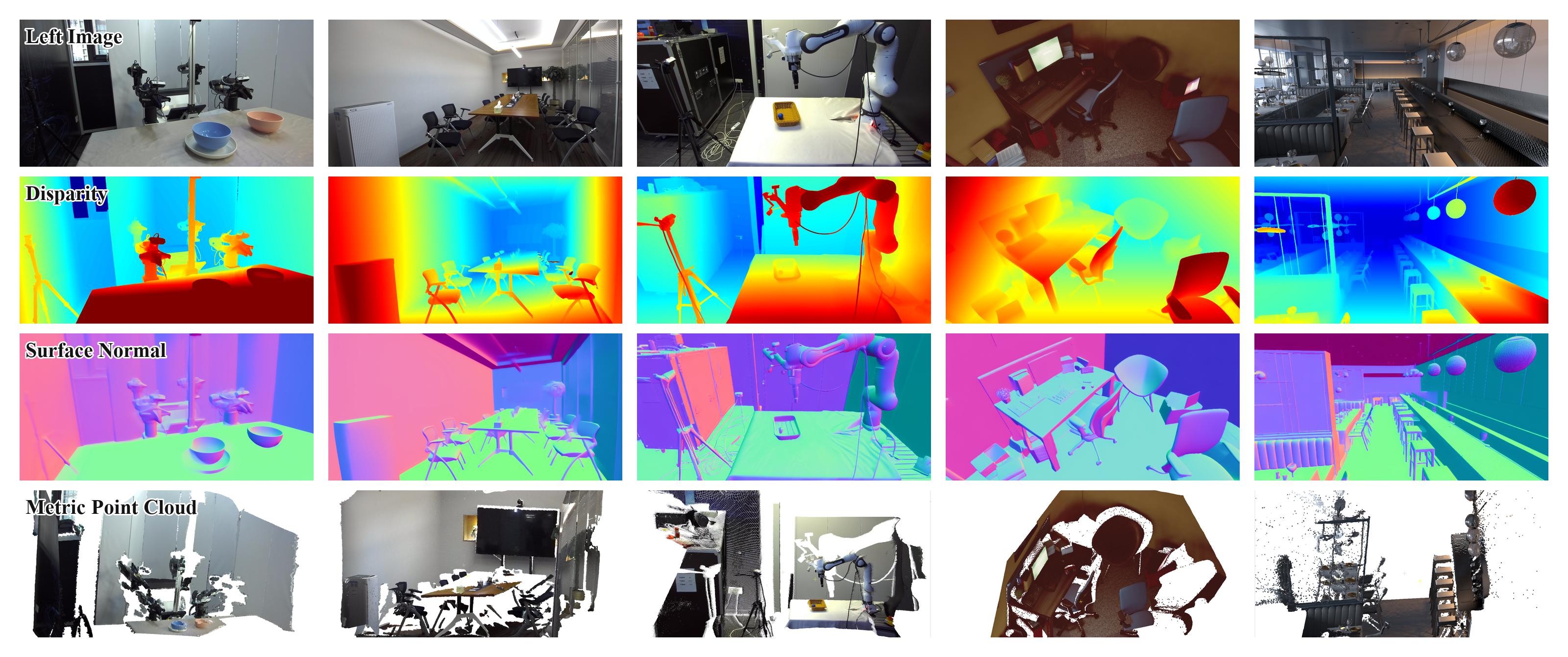
Qualitative comparison of zero-shot inference on diverse scenes. All methods are trained on a mixture of public datasets. The examples include challenging cases such as low-light conditions, reflections, and transparent objects. The top three rows show disparity results, while the bottom row shows surface normal predictions.